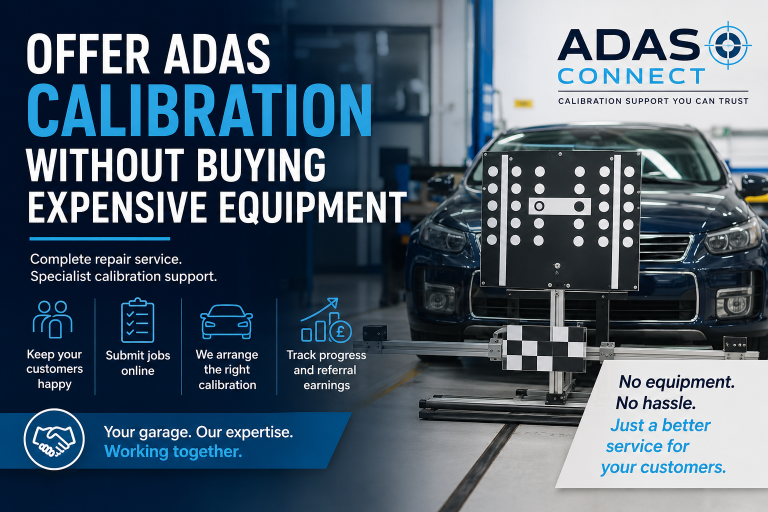

Why ADAS Calibration Is Essential After Windscreen, Bumper or Body Repairs
Modern vehicles are no longer just mechanical. Many now rely on cameras, radar sensors and driver assistance systems to help keep the vehicle, driver, passengers and other road users safe.
These systems are known as ADAS, or Advanced Driver Assistance Systems. They can include features such as lane assist, adaptive cruise control, emergency braking, traffic sign recognition, parking sensors, blind spot monitoring and collision warning systems.
Because these systems depend on accurate sensor positioning, even a small change to the vehicle can affect how they perform. That is why ADAS calibration is so important after work such as a windscreen replacement, bumper repair, accident repair or certain mechanical repairs.
Why a Windscreen Replacement Can Affect ADAS
Many vehicles have a forward-facing camera mounted behind the windscreen. This camera may be used for lane departure warning, automatic emergency braking, traffic sign recognition and other safety systems.
When a windscreen is replaced, the camera may be removed and refitted. Even when the new windscreen is installed correctly, the camera position can change slightly. That small change may be enough to affect how the vehicle reads the road ahead.
This is why windscreen camera calibration may be needed after a replacement windscreen. In simple terms, the car needs to know exactly where the camera is pointing. If it is not calibrated correctly, the vehicle may misread lane markings, traffic signs, distance from other vehicles or potential hazards.
Why Bumper Repairs and Accident Repairs Matter Too
ADAS calibration is not just about windscreens.
Many radar sensors and parking-related systems are fitted behind bumpers, grilles and body panels. If a bumper is removed, repaired, painted, filled or replaced, it can affect the way radar and sensor signals pass through the panel.
This is especially important for systems such as:
- Adaptive cruise control
- Front collision warning
- Automatic emergency braking
- Parking assistance
- Blind spot detection
- Rear cross-traffic alert
A bumper may look perfectly fine after repair, but the sensors behind it still need to be checked. If a radar sensor is slightly misaligned, the vehicle may not judge distance correctly. That could affect how quickly the car reacts in an emergency.
After accident damage, panel replacement or bumper work, post-accident ADAS calibration may be required before the vehicle is returned to the road.
Insurance and ADAS Calibration
ADAS calibration is also important from an insurance and repair compliance point of view.
When a vehicle is repaired following an accident or insurance claim, the repair should return the vehicle to the correct safe standard. If the manufacturer says calibration is required after a certain repair, then skipping it may mean the repair is incomplete.
This matters because insurers, repairers and bodyshops need to know that the vehicle’s safety systems are working as intended before it goes back on the road.
For garages, repairers and bodyshops handling this type of work, ADAS Connect can also help with trade ADAS calibration quotes and support for customer vehicles after repair.
For drivers, this means ADAS calibration is not just an optional extra. In many cases, it is part of carrying out the repair properly.
The Safety Risk of Skipping Calibration
ADAS systems are designed to help in moments where accuracy matters.
If a camera, radar or sensor is not correctly calibrated, the vehicle may:
- Fail to detect a lane marking correctly
- Misjudge the distance to another vehicle
- React too late or too early
- Give incorrect warnings
- Fail to activate a safety feature when needed
- Show no obvious dashboard warning, even though performance is affected
That last point is important. A vehicle may appear to drive normally even when calibration is needed. The dashboard may not always tell the driver that the system is out of alignment.
This is why proper diagnostic checks and calibration procedures are so important after windscreen, bumper and accident repairs.
When Might ADAS Calibration Be Needed?
ADAS calibration may be required after:
- Windscreen replacement
- Front or rear bumper removal
- Bumper repair or replacement
- Accident damage repair
- Radar sensor replacement
- Camera replacement
- Suspension work
- Wheel alignment
- Steering geometry changes
- Grille or panel replacement
- Certain diagnostic or module programming work
The exact requirement depends on the vehicle manufacturer, model and repair procedure. In some cases, mobile ADAS calibration may be possible, while other vehicles may require workshop-based equipment and specific calibration conditions.
That is why it is important to check the correct repair information rather than guessing.
ADAS Connect Can Help
At ADAS Connect, we help drivers, garages, bodyshops and trade customers arrange ADAS calibration support.
Whether the vehicle has had a windscreen replaced, a bumper repaired, accident damage fixed or a sensor disturbed, we can help route the enquiry to suitable ADAS calibration support.
We currently support enquiries for ADAS calibration in Manchester and across the North West, while also building a wider UK support network.
Modern vehicles rely on accurate cameras, radar and sensors. Calibration helps make sure those systems are working as the manufacturer intended.
If your vehicle has recently had a windscreen replacement, bumper repair or bodywork completed, do not assume the job is finished until the ADAS systems have been checked.
Need help after a windscreen replacement, bumper repair or accident repair? Request an ADAS calibration quote and send us the vehicle details, postcode and reason calibration may be needed.